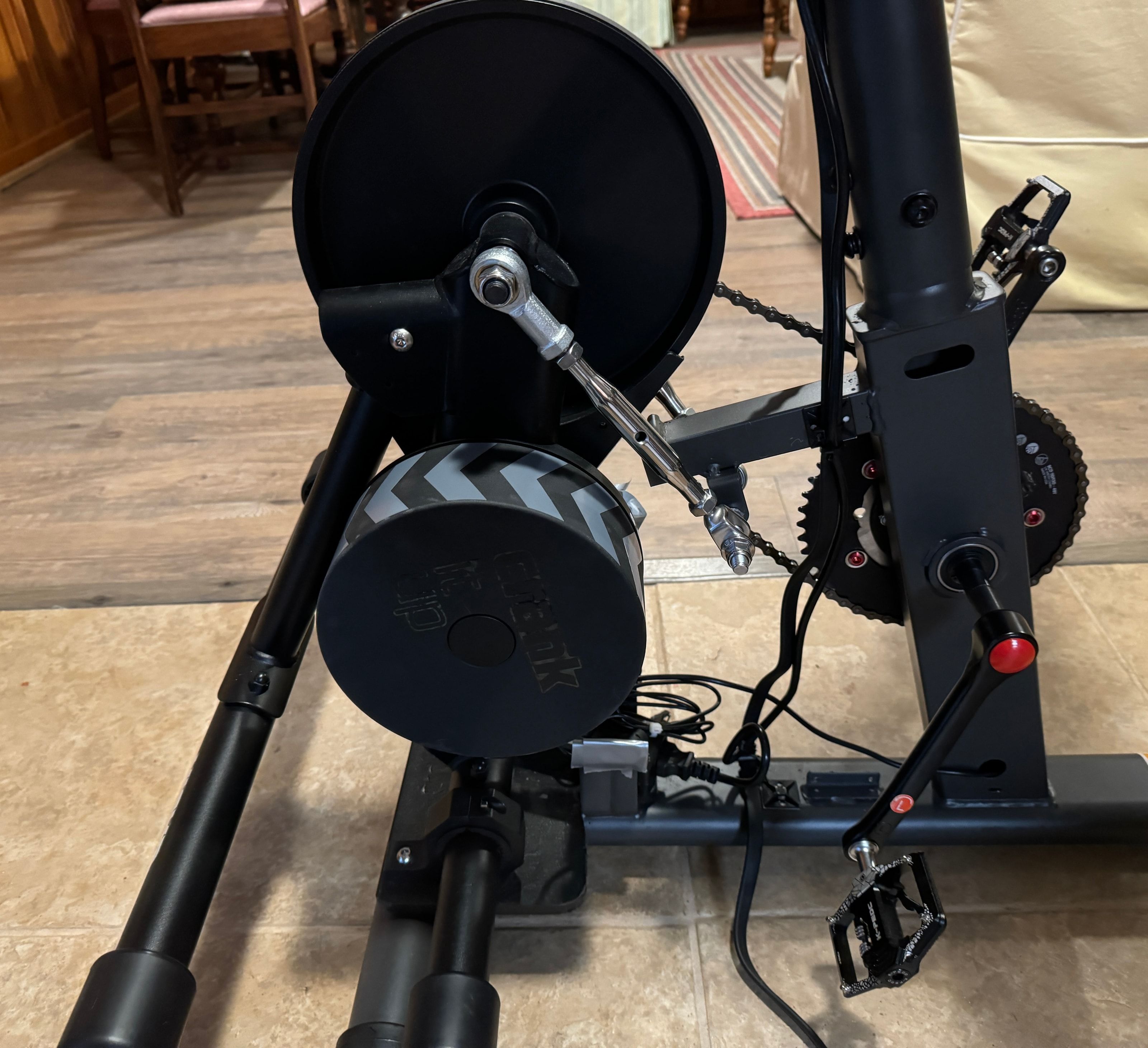
It can become a component
The most important feature is physical rather than digital. The CORE is compact, and the crossbars on both legs can be removed. That lets me stop treating it as a floor-standing bicycle trainer and start treating it as a controllable resistance unit that can sit beside another frame.
That physical minimalism is why it appears in the BH R8, Schwinn, Assault AirBike, Rogue Echo, and Bowflex experiments. I still have to solve the mount, input speed, drivetrain, guards, and clearances for each machine, but the trainer itself does not occupy more room than it needs.
The connections I used
Multiple Bluetooth roles
In my setups, the CORE could participate in the app and control arrangements I needed without making one connection the entire architecture.
Responsive resistance
It exposed the familiar smart-trainer controls expected by virtual cycling apps and by my own control experiments.
Virtual shifting
Compatible software and controls could provide gearing without requiring a conventional cassette and derailleur on the machine.
A connection I still wanted
I would have welcomed network connectivity or a direct wired option for installations where Bluetooth is not the ideal path.
Virtual gearing changes the mechanical brief
A single mechanical ratio is not the same as a single workout effort. Zwift Click can supply virtual shifts in a compatible Zwift setup. Other applications have their own virtual gearing or resistance controls. Some can vary resistance with music or expose manual controls that behave more like a transmission.
That flexibility lets a FrankenTrainer use a chain or belt path chosen for reliable motion rather than trying to reproduce a road bicycle's full drivetrain. It does not remove the need to choose a sensible mechanical ratio; it changes what that ratio has to accomplish.
Why this is not a universal recommendation
I could find used and reconditioned CORE units when these builds began, which made experimentation less precious. Availability, revisions, software support, and prices change. Another compact trainer may be a better starting point for another builder.
The useful selection test is broader than a logo: Can the trainer fit safely? Can the machine drive it through a suitable speed range? Does it expose the control modes the intended software needs? Can the modified assembly be mounted, guarded, and inspected?